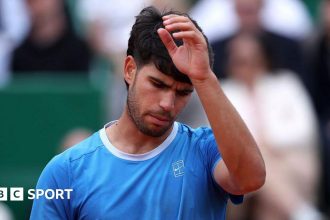
Tournament director Amelie Mauresmo has promised there will be no expansion of cameras in player areas at Roland Garros this year.
Iga Swiatek said players were being watched “like animals in the zoo” at January’s Australian Open.
Coco Gauff called for more privacy after being caught on camera smashing her racquet at Melbourne Park, and Pegula described the constant filming as an “invasion of privacy”.
“The broadcasters want to know more about players – it’s true,” Mauresmo said at the news conference in Paris.
“But we want to maintain the respect for their privacy. They need to have a private area, so we won’t change on that stance.”
Some players will also be happy to know they will be allowed to wear approved fitness trackers for the first time at Roland Garros.
Aryna Sabalenka, Jannik Sinner and Carlos Alcaraz were all asked to remove devices before matches at the Australian Open, but a trial has now been agreed which will extend to Wimbledon and the US Open.
Tracking technology can help monitor a person’s sleep, strain, stress and heart, and has been allowed on the WTA and ATP Tours for some time.
One tradition which will remain at Roland Garros for at least another year is line judges.
The other three Grand Slams have introduced electronic line calling (ELC) in recent years, and it has been mandatory on the ATP Tour since 2025.
But Gilles Moretton, the president of the FFT, maintains the technology is far from perfect and that line judges play a vital role in the ecosystem of French tennis.
“We look around, we see what is going on elsewhere, we see that it’s not perfect – there’s a 10% margin of error,” Moretton claimed.
“We saw it in Madrid last year. There was a picture taken by a player [Alexander Zverev – of a mark on the clay].
“But we have tournaments every weekend, every week. We need these people, they do a wonderful job.
“On clay, we are lucky because we can have the footprints of the balls.”