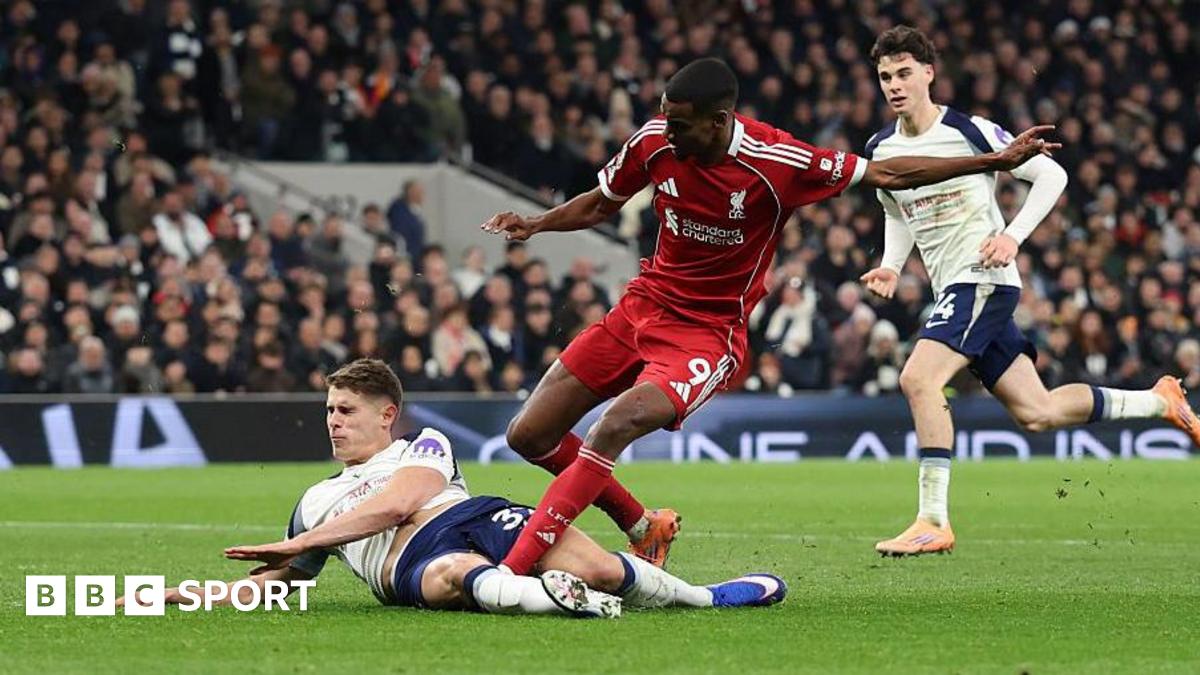
Tottenham boss Thomas Frank was not happy with several decisions which went against his side in Saturday’s 2-1 home loss.
Xavi Simons was sent off after catching Virgil van Dijk on the back of the calf as he closed down the Liverpool defender.
Referee John Brooks had only shown a yellow card, but was sent to the pitchside monitor by the VAR Stuart Attwell.
Frank said “the game is gone if that’s a red card”. Yet the consensus among former players was it was the right decision.
On Match of the Day, Joe Hart said: “That is such a dangerous tackle, he’s caught him on the back of the Achilles, it’s absolutely a red card.”
Referees’ chief Howard Webb last season made it clear this kind of challenge should lead to a VAR review.
His comments came after Leicester City’s Wilfred Ndidi was not sent off after raking his studs down the calf of Chelsea’s Cole Palmer in an incident which was similar to Simons on Van Dijk.
Webb said of Ndidi’s foul: “We’ve looked at this collectively, among the officials, talked about this, and we would prefer this to be dealt with with a red card. We have to protect player safety.”
But what about a possible red card for Alejandro Garnacho earlier in the day? The Chelsea forward only received a caution for his foul on Newcastle’s Jacob Ramsey.
The decision of referee Andy Madley was supported by the VAR Peter Bankes.
There are some important differences to consider.
The ball was in playing distance when Garnacho started the challenge. While he did then lead into Ramsey with his studs there was no force or intensity – and only a small amount of contact.
If a player is stepping into a tackle and mistimes it slightly a caution is seen as an acceptable disciplinary outcome, even if initial contact is above the boot.
Challenges from behind, as with Simons, where there is no possibility of getting to the ball are far more likely to result in a red card.